
How to Know If You Have the Right People in the Right Seats
Most leadership problems are people problems. Bad culture fit in your ops role? Your processes crumble. Wrong salesperson in a closing seat? Revenue stalls. Right person, wrong seat? They burn out and leave.
Pinnacle's approach is simple: score every seat-holder on two dimensions and act.
The Talent Assessment
The Talent Assessment Chart is a topgrading tool that provides a clear definition of "A" players by measuring employees on a two-axis scale. The X-axis measures the productivity of the employee based on results or KPI's for their specific role. The Y-axis measures the employee based on how they live the culture of the organization.
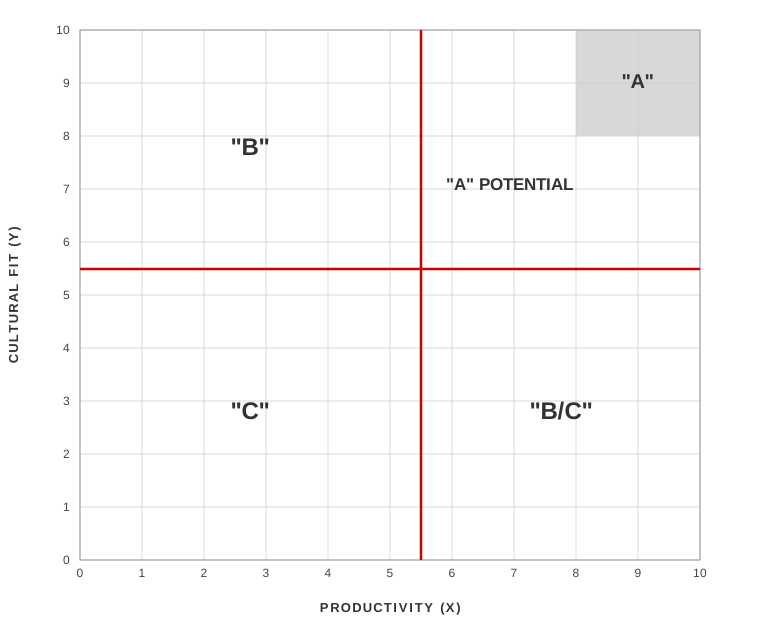
Plot every person on a 10×10 scored grid:
- X-axis (Productivity): Can they do the job? Do they deliver results and hit their KPIs?
- Y-axis (Cultural Fit): Do they live the values? Do they show up the way the organization needs them to?
Red lines cross at approximately 5.5 on both axes — defining five categories:
- "A" (8+/8+) — High cultural fit, high productivity. The best. Keep, develop, promote.
- "A" Potential (6+/6+ but below 8 on one or both) — Close to "A" status. One development gap away.
- "B" (high cultural fit, low productivity) — Lives the values but underperforms on results. May be in the wrong seat.
- "B/C" (high productivity, low cultural fit) — Produces results but doesn't align with culture. Risky.
- "C" (low on both) — Not a fit on either dimension. Move on.
The Five Categories
"A" (High Productivity, High Cultural Fit — 8+/8+)
- These are your keepers.
- Invest in them. Develop them. Give them bigger seats as the company grows.
- They're rare. Protect them.
"A" Potential (6+/6+ but not yet at 8+ on both)
- Close to "A" status but needs development on productivity, cultural fit, or both.
- Invest in a clear 90-day plan. Define what "A" looks like in their seat and close the gap.
- High return on coaching investment.
"B" (Low Productivity, High Cultural Fit)
- They live the values but can't execute in their current seat.
- Often fixable — wrong role, wrong skills, or wrong support.
- Invest in development first. If no improvement in 90 days, move them to a smaller seat or off the team.
"B/C" (High Productivity, Low Cultural Fit)
- They deliver results but they don't fit the culture.
- This is your biggest blind spot. High output masks the damage they're doing.
- Two paths: help them realign with clear values coaching, or move them out. Some of your best individual contributors are "B/C" in leadership roles — get them out of leadership seats.
"C" (Low Productivity, Low Cultural Fit)
- Their presence erodes culture and results simultaneously.
- Move on quickly. This is the clearest call on the chart.
How to Score Each Seat
Be honest. The assessment is private, but it has to be real.
Productivity (scale 1–10):
- 1–3: Consistently misses targets, requires heavy management
- 4–6: Hits some goals, but inconsistently
- 7–8: Regularly delivers, meets expectations
- 9–10: Exceeds goals, raises team performance
Cultural Fit (scale 1–10):
- 1–3: Works against team values, actively divisive
- 4–6: Neutral — doesn't reinforce values but doesn't undermine them
- 7–8: Actively demonstrates values, supports culture
- 9–10: Embodies values, others follow their lead
The Hard Conversations
Once you've mapped your team, you need to act. That means:
"A" Players: Celebrate. Invest. Give them equity, growth, autonomy.
"A" Potential: Development plan. "Here's what 'A' looks like in your seat. Here's the gap. Here's the help we're providing. Let's check in monthly."
"B": Support plan. "Here's what success looks like for your role in the next 90 days. Here's the help we're providing. Let's check in monthly."
"B/C": Direct conversation. "You're excellent in execution. Here's where we need cultural alignment." Coaching or repositioning. Act fast — every week they stay, they're shaping culture.
"C": Exit conversation. "This isn't working. Here's what happens next."
The Timing
Do this once per quarter, at minimum. Your Tactical Meeting is the right place for it. 20 minutes: review scores, identify the "B/C" and "C" players who need moves.
Many leaders avoid this. They hope things improve on their own. They don't. Your "C" player stays, takes up 20% of your energy, and infects culture.
The Reality
You probably have 20–30% of your seats misaligned. That's not a failure of hiring — it's the reality of growth. People who were excellent at $5M revenue might not be the right fit at $50M. Good people in the wrong seat. It happens.
The Pinnacle Talent Assessment gets you clear and moving fast. For a deeper look at the full framework, see Right People Right Seats: The Framework That Transforms Businesses.
Ready to audit your team? Chat with our AI Guide. It'll walk you through scoring and planning your first repositioning.